


Hot Steel Descaling Systems: How to Specify One
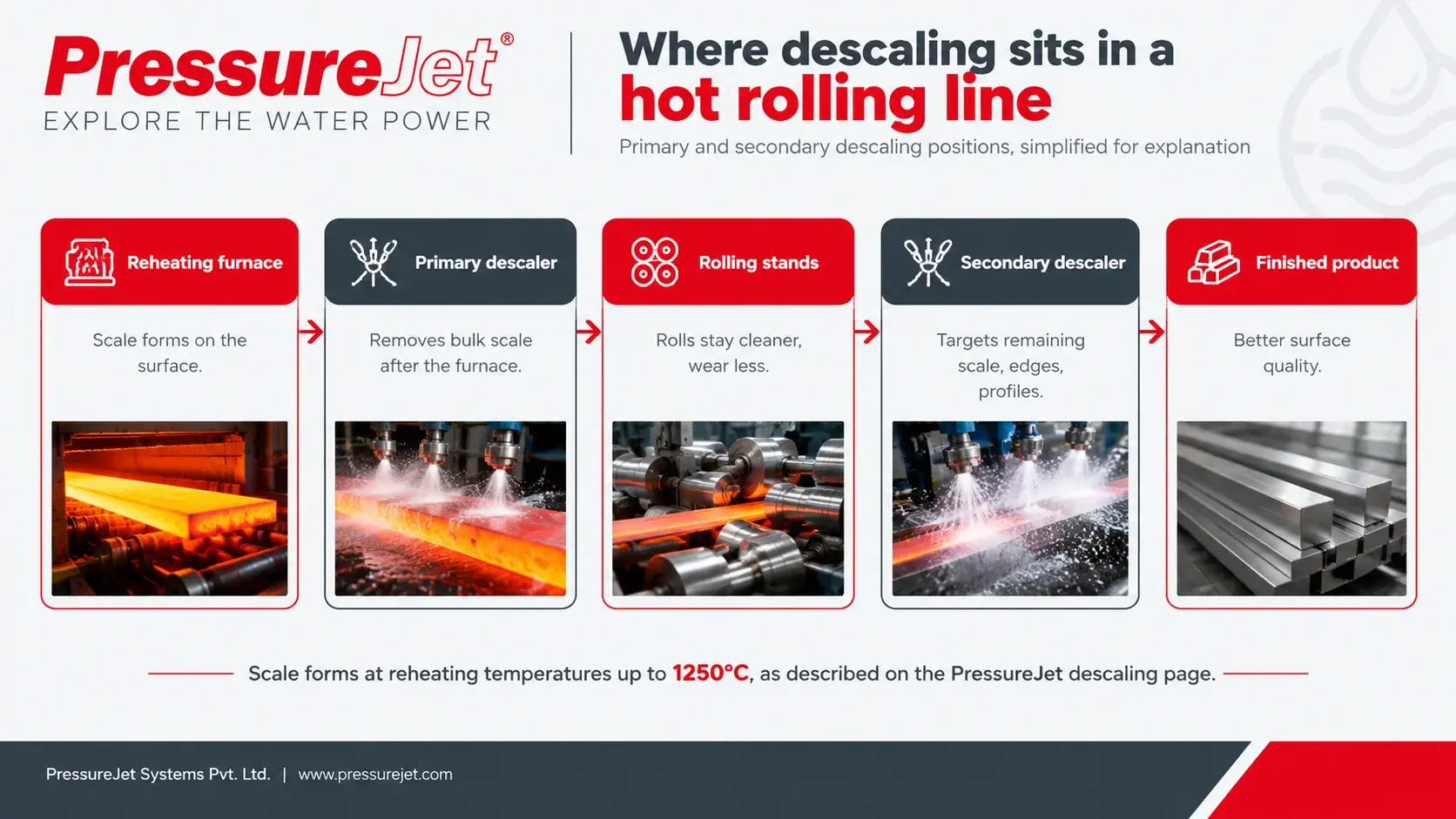
Primary and secondary descaling improve steel surface quality throughout the hot rolling line.
A rolling mill does not buy a descaling system the way it buys a spare bearing. The system is a chain of parts that must work together: a pump, a drive, valves, headers, nozzles, filters and controls. If the specification is vague, each supplier fills the gaps with their own assumptions, and the quotations that come back cannot be compared fairly.
This guide shows what to define before you contact a manufacturer. It is written for steel plant engineers, project teams and purchase managers who are planning a new descaler, replacing an old one or upgrading a line. It draws on what PressureJet publishes about its hot steel descaling range, and it separates plant data you must supply from design choices the manufacturer should confirm.
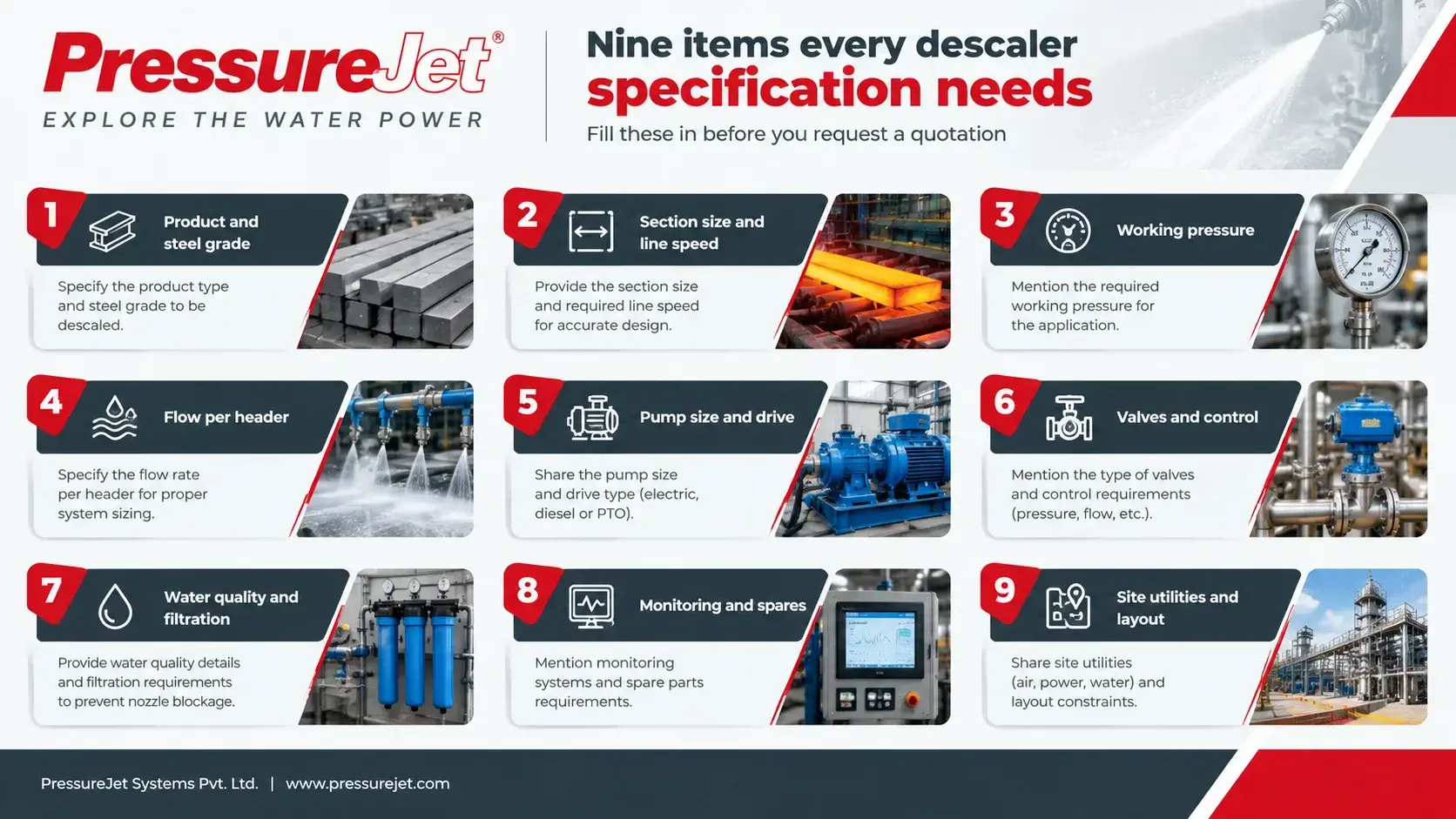
Quick answer: To specify a hot steel descaling system, define the product and steel grade, section size and line speed, working pressure, flow per header, pump size and drive, valve and control philosophy, water quality and filtration, monitoring needs and site utilities. Send these to the manufacturer so the pump, headers and nozzles are designed as one system.
What a descaling system does and why it matters
When steel is reheated in a furnace, oxygen and process gases react with the surface and form scale. PressureJet notes that this happens at temperatures up to 1250 degrees Celsius. If the scale stays on, it can press into the product during rolling and spoil the surface, and it can speed up wear on the rolls.
A descaling system removes that scale with high pressure water jets. The jets strike the surface with enough impact to break the oxide layer loose, and angled jets wash the loosened scale away. PressureJet states that its hot steel descaling system reaches more than 90 percent scale removal efficiency, using header design and impact force calculations matched to the material and furnace type. Treat any such figure as a design target to confirm for your own line, since results depend on your steel, temperature and layout.
Primary and secondary descaling: decide which you need
Many specifications go wrong at the first step because the buyer asks for "a descaler" without saying where it sits in the line. PressureJet describes two roles.
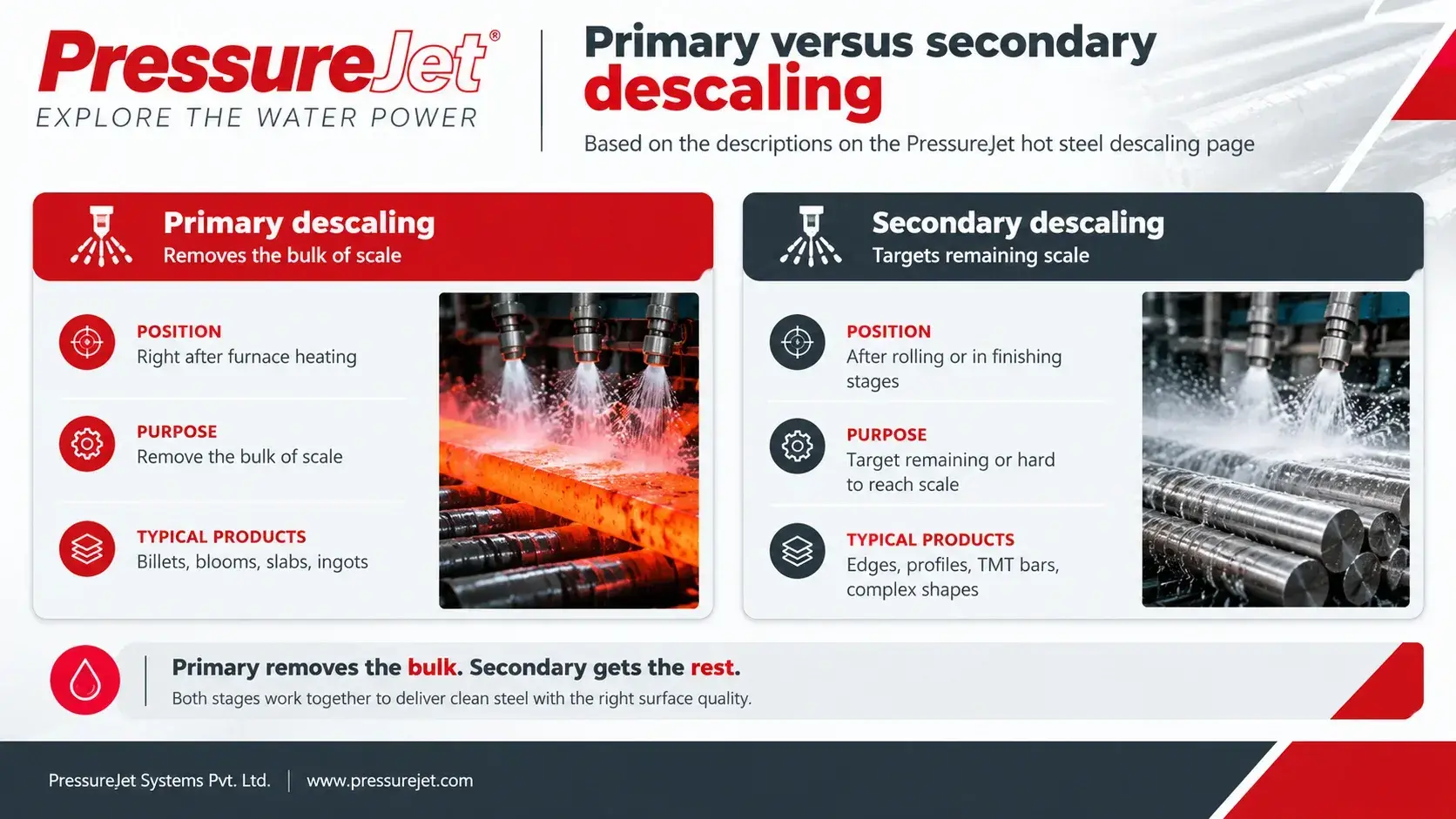
Primary descaling removes the bulk of the scale right after furnace heating. It suits billets, blooms, slabs and ingots, where the aim is a uniform strike across the whole surface.
Secondary descaling deals with scale that remains, or that is hard to reach. It suits edges, profiles, TMT bars and complex shapes.
Some lines need both. State clearly which positions you are specifying, because the header layout, the flow and the control timing differ between them.
The nine items a descaler specification should contain
The checklist below gives a project team a structure to follow. Each item is explained in the sections that follow.
1. Product and steel grade
List every product the descaler must handle: billets, blooms, slabs, pipes, TMT bars, ingots, profiles or wire rods. Add the steel families you roll, such as mild steel, high carbon steel, alloy steel, bearing steel, tool steel or stainless steel. PressureJet says it tailors its solutions to all of these, and the grade matters because it changes how scale forms and how firmly it sticks.
2. Section size and line speed
Give the width, thickness or diameter range of the product and the speed at which it passes the descaler. These two inputs decide how wide the jet coverage must be and how long each point on the steel is exposed to the water. A fast line with a wide product needs a different header from a slow, narrow one.
3. Working pressure
PressureJet lists its descaling range at 150 to 400 bar. Do not pick a number from the top of that range by habit. The right pressure depends on the impact force needed for your steel and furnace conditions, and it is a result of the design calculation, not a starting assumption. Ask the manufacturer to show how the pressure was chosen.
4. Flow per header
Flow is set by the nozzles on the header. Count the nozzles, note their size and add the flow at the working pressure. Descaling needs a lot of water compared with cleaning duties, which is why a descaling pump is selected for flow as much as for pressure. A useful starting point for any plunger pump is the relationship kW = bar x LPM / 600, which gives hydraulic power before losses. You can read the wider logic in our High Pressure Plunger Pumps range overview.
5. Nozzle type and jet angle
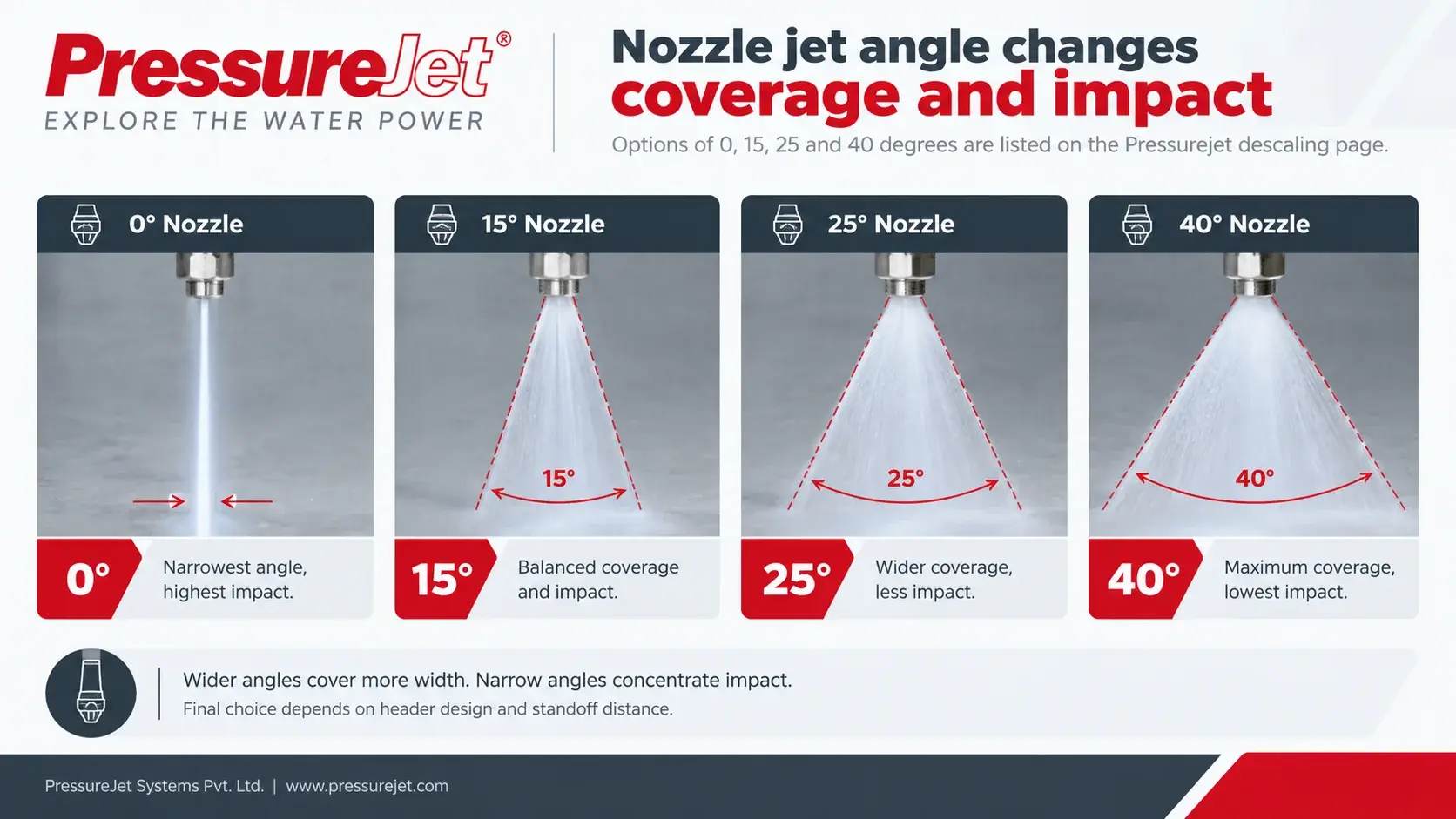
The nozzle turns pressure into impact. PressureJet lists descaling nozzles in 0, 15, 25 and 40 degree jet configurations, made from hardened stainless steel or tungsten carbide. A narrow jet concentrates force, while a wide jet covers more width. The header spacing and the distance between nozzle and steel have to be designed together.
6. Pump size and drive
Once pressure and flow are known, the pump follows. PressureJet's ESB series for descaling is listed at 150 HP to 180 HP and can be electric motor driven, diesel engine driven or PTO driven. The datasheet notes that a diesel engine needs about 20 percent more HP than the equivalent motor. If you want a 150 HP descaling pump for a line that suits it, the ESB page lists the model data discussed below.
7. Valves and control
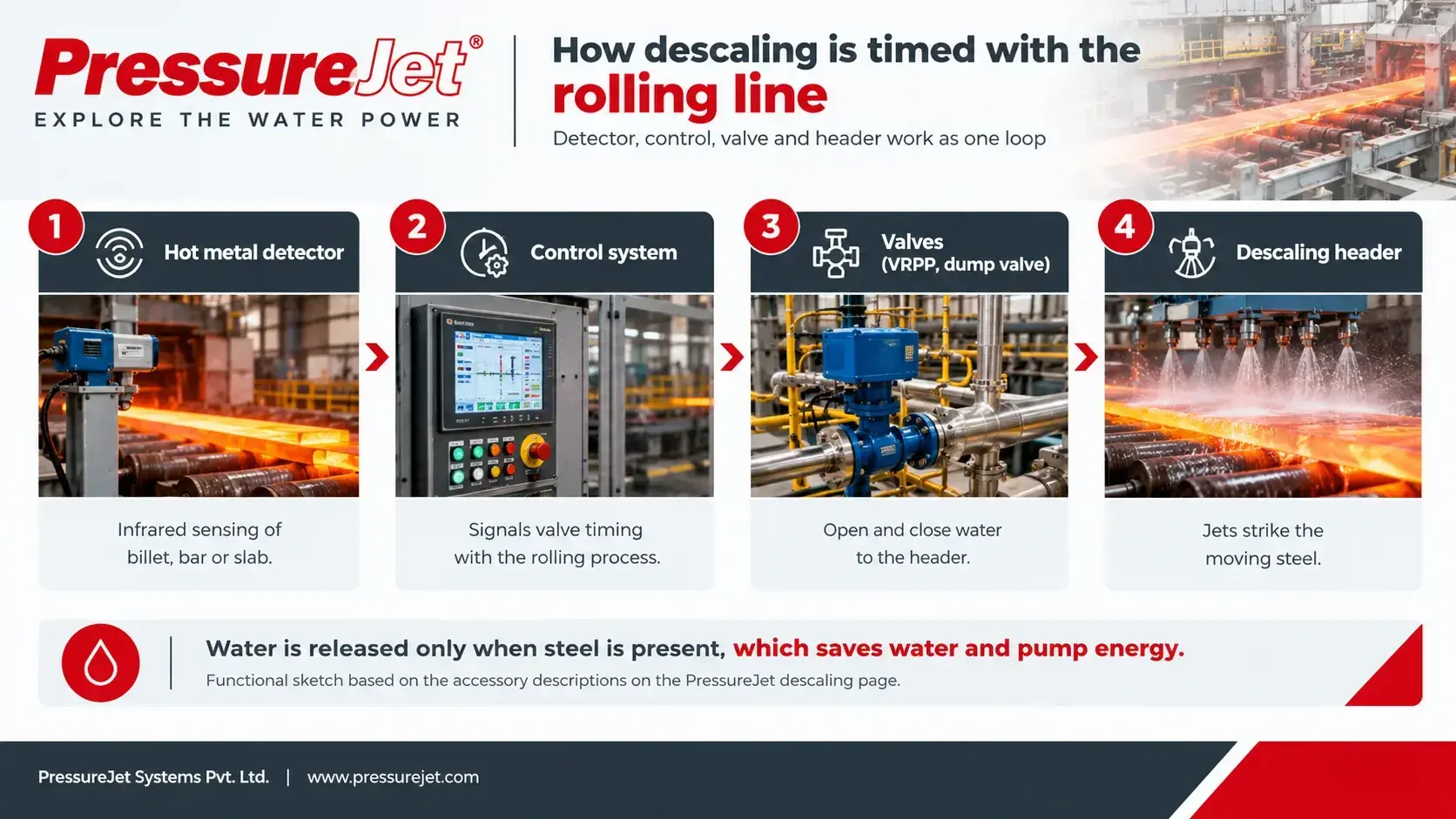
Descaling water should flow only when steel is under the header. PressureJet lists an infrared hot metal detector that senses billets, bars or slabs and triggers valve actuation in step with the rolling process. It also lists a VRPP pneumatic valve for pressure regulation and a heavy duty dump valve for fast on and off response, with the DV 80 described for continuous operation at 350 bar. Specify who supplies the control logic and how the detector signal reaches the valves.
8. Water quality and filtration
Plunger pumps and descaling nozzles do not tolerate grit. PressureJet lists an 80 to 100 micron sand filter for descaling duty, and the ESB datasheet gives the inlet condition as flooded suction up to 2 bar and a working fluid temperature of 60 degrees Celsius. Record your water source, temperature and cleanliness in the specification, and state whether a scale pit or recirculation system will feed the pump.
9. Monitoring and site layout
Ask what monitoring is included. PressureJet lists a telematic IoT system that tracks pressure, flow, temperature and vibration with cloud logging, plus a VFD control panel for speed and pressure control. Add the physical facts of the site: pump house location, pipe run length, available power and floor space. A bare ESB pump weighs 430 kg, so foundations and lifting access need planning from the start.
How to read an ESB series datasheet
A datasheet is easy to misread, so it helps to see how the numbers connect. The ESB page lists the ESB 40-565 delivering 153 LPM at 375 bar with 150 HP, and at 400 bar with 180 HP. The ESB 40-675 delivers 182 LPM at 400 bar with 180 HP. Notice that pressure and flow sit together in every row. When a quotation quotes pressure without flow, or flow without pressure, ask for both.
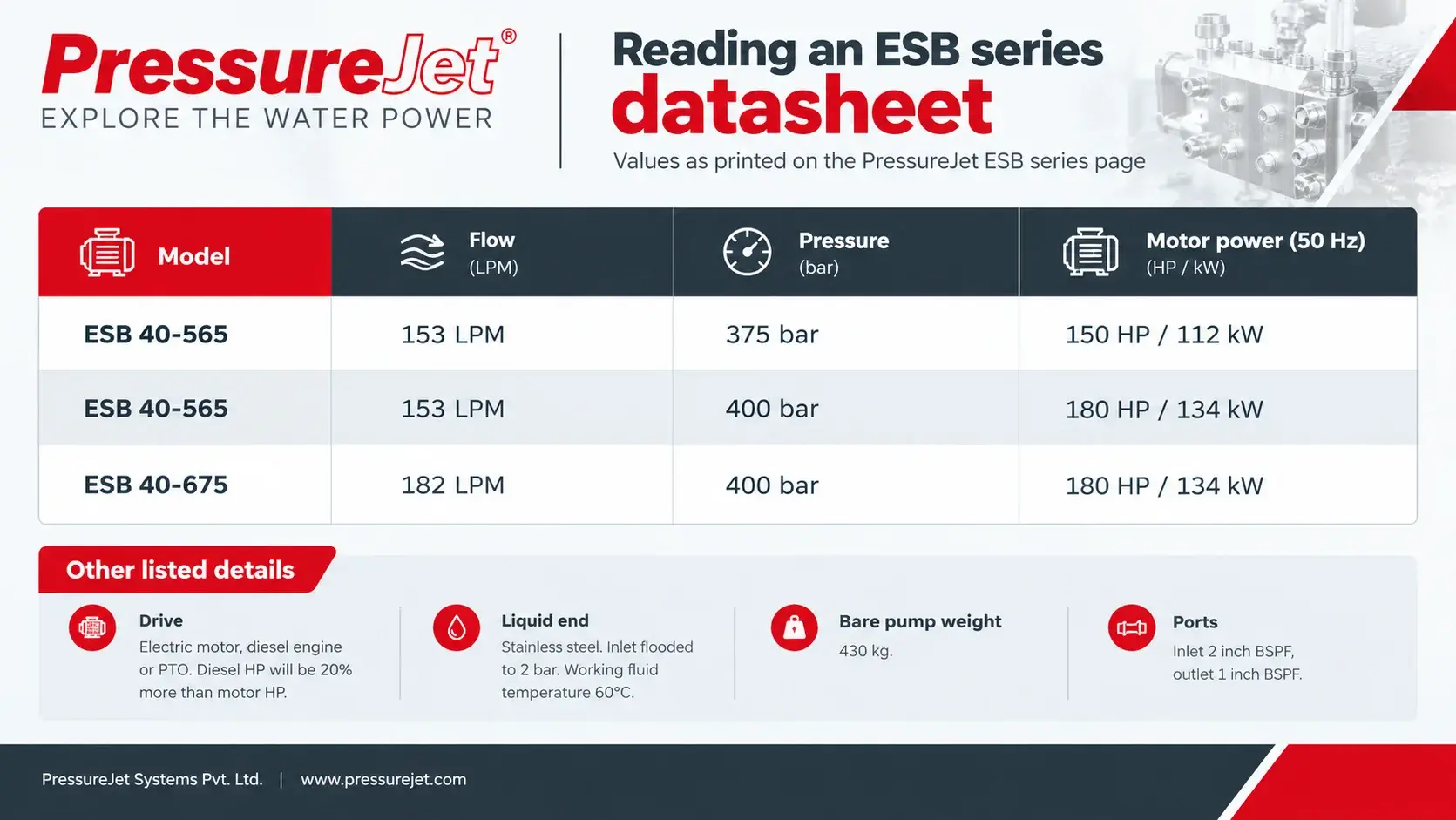
Also check that the number of pumps matches the total header flow. A single pump rated at 153 or 182 LPM will not feed a header that needs more than that, so the design may use more than one pump. Ask the manufacturer to show the flow balance in the proposal.
Descaling is not the same as other high pressure duties
The same triplex plunger technology serves many jobs, and that can cause confusion during enquiries. A descaler for a hot line is not the right tool for general plant housekeeping. For washing equipment, floors or shutdown cleaning, a separate industrial high pressure cleaner is the usual choice. For removing rust, paint or scale from cold fabricated parts, abrasive methods such as a water sand blasting machine fit better than a mill descaler. Vessel internals follow their own cleaning system and reactor cleaning process.
Fire protection is also separate. PressureJet publishes pages on a UHP fire fighting pump and a high pressure water mist system. They share pump technology with descaling, but they are specified by different rules, so keep them in separate scopes.
Mistakes that appear again and again
- Asking for a pump size before the header and nozzle design is known.
- Specifying pressure alone and leaving flow out.
- Leaving the valve and detector scope unassigned, so nobody supplies the timing logic.
- Ignoring water cleanliness, then replacing valves and nozzles too often.
- Comparing quotations that assume different products, speeds or pressures.
- Forgetting spares planning until after the first outage.
What to send with your enquiry
A clean enquiry shortens the quotation cycle, and it helps the manufacturer decide quickly whether the standard hot steel descaling system configuration fits your line or whether a custom layout is needed. It also lets you compare proposals on the same basis, which is the real purpose of a specification. Send these points to the manufacturer:
- Primary, secondary or both, and the position in the line.
- Products, steel grades and the size range.
- Line speed and temperature at the descaler.
- Target pressure, or the impact requirement if known.
- Header count, width and the nozzle layout if you already have one.
- Electric, diesel or PTO drive and the power available.
- Water source, temperature, filtration and recirculation plan.
- Control and monitoring requirements, including the detector and valves.
- Delivery schedule and shutdown window.
Plan service and spares before purchase
A descaler runs in a hard environment, so service planning belongs in the specification. PressureJet states that its plunger pumps complete a minimum 200 hour continuous test at rated pressure, that it reports over 85 percent mechanical and volumetric efficiency for its pump range, and that it keeps spare parts in stock. Ask any supplier to state its own test and service commitments in writing. As a high pressure plunger pump manufacturer, PressureJet also publishes maintenance videos and a spare parts section for its users.
Frequently asked questions
What pressure does a hot steel descaling system need?
PressureJet lists its descaling range at 150 to 400 bar. The right pressure depends on your steel, furnace conditions and the impact force the design calculation requires, so confirm it with the manufacturer instead of choosing from the top of the range.
What is the difference between primary and secondary descaling?
Primary descaling removes the bulk of the scale right after furnace heating, mainly on billets, blooms, slabs and ingots. Secondary descaling targets leftover or hard to reach scale, such as edges, profiles and TMT bars.
How do I work out the flow a descaler needs?
Add the flow of every nozzle on the header at the working pressure. Then check that the pump or pumps can supply that total. A pump datasheet quotes flow and pressure together, for example 153 LPM at 375 bar for the ESB 40-565.
Why is a hot metal detector used with a descaler?
The detector senses when steel is present and triggers the valves in step with the rolling process. This keeps water off when no steel is under the header, which avoids wasted water and pump energy.
What information should I send to a descaling system manufacturer?
Send the product and steel grade, section size, line speed, descaler position, target pressure, header details, drive type, water quality, control needs and the shutdown schedule. With these, the manufacturer can match the pump, headers and nozzles as one system.
Planning a new or upgraded descaler? Share your product, line speed, pressure and drive details through the PressureJet enquiry page, call +91-9375022359 or write to sales@pressurejet.com. The team can review your data and suggest a configuration.
Back to Blog
Parameters

Customers

Manufacturing

Expertise