


500 Bar Plunger Pump AMC Service and Pump Manufacturer in Ahmedabad What Industries Should Expect
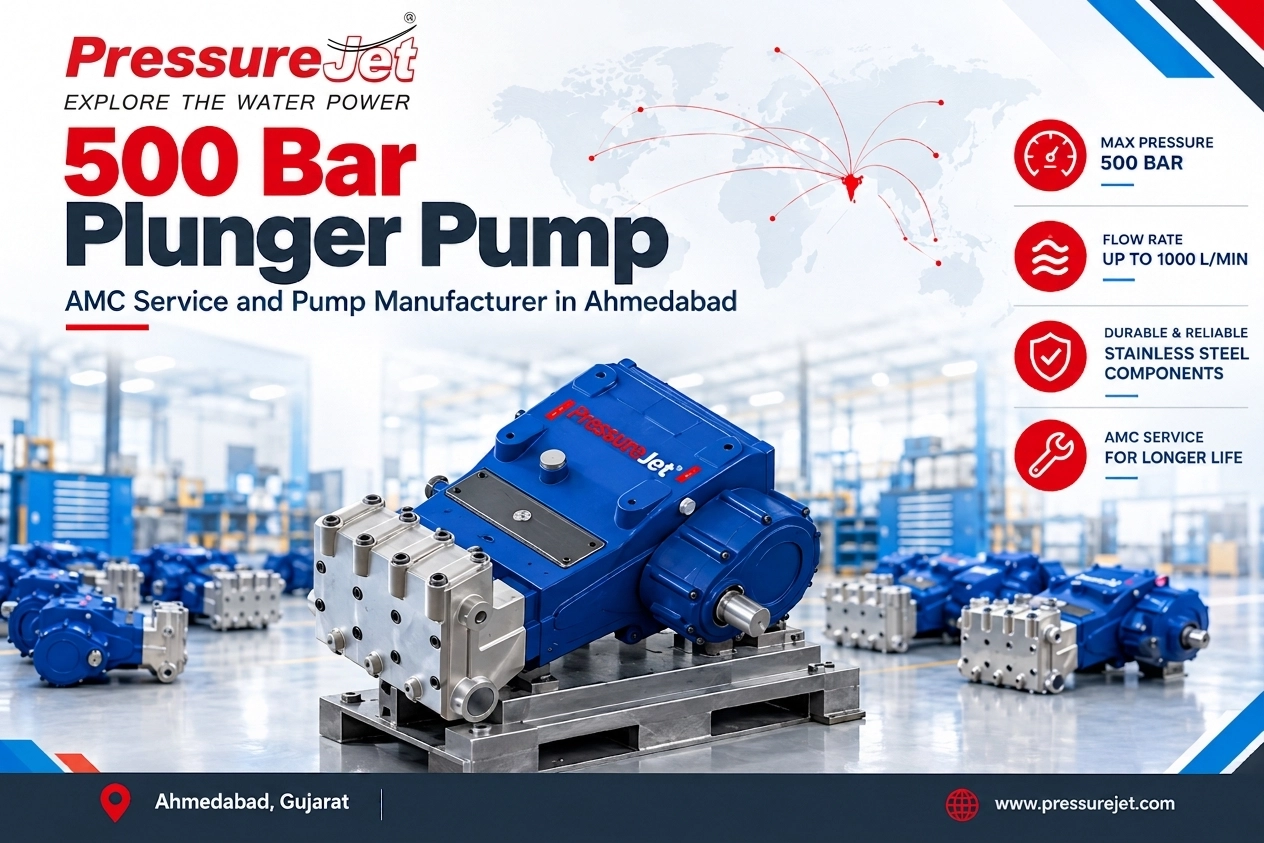
Precision testing and quality assurance for industrial high-pressure plunger pumps.
Quick answer: A 500 bar plunger pump needs a planned Annual Maintenance Contract (AMC) because its packings, valves, seals, and plungers wear on a predictable schedule. The safest setup is a pump manufacturer in Ahmedabad that builds the pump, tests it, stocks the spares and services it under one roof. PressureJet does this for steel, sugar, shipyard, pipeline and municipal customers.
When a 500 bar plunger pump stops, the line it feeds stops with it. A descaling header goes quiet, a hydrotest runs past its window, a tube bundle stays dirty, a shipyard crew waits. Buyers often spend weeks comparing pump specifications and almost no time asking the question that matters on day 400: who will keep this pump running, and how fast can they reach us?
This guide answers that question. It explains what wears in a 500 bar pump, what a sensible AMC should contain, why buying from a local manufacturer changes the outcome, and how PressureJet backs its pumps with testing, quality control and ready spares.
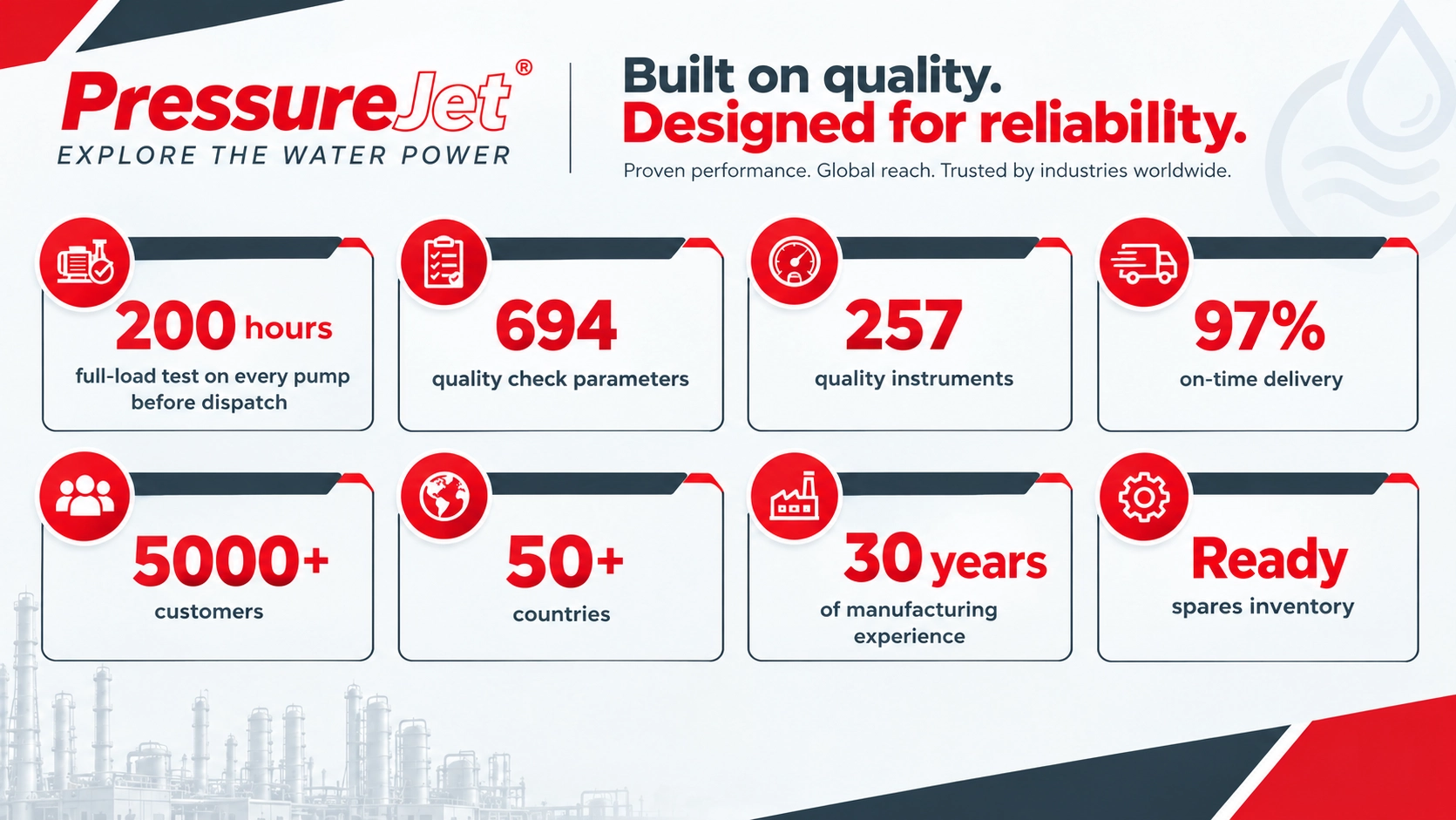
PressureJet at a glance
- 200-hour full-load test on every pump before dispatch
- 694 quality check parameters
- 257 quality instruments
- 97% on-time delivery
- 5000+ customers
- 50+ countries
- 30 years of manufacturing experience
- Ready spares inventory
Why 500 bar duty changes the service conversation
At low pressure, a plunger pump forgives neglect. At 500 bar it does not. Every stroke loads the plunger, the packing and the discharge valve with a force that grows with pressure, so small leaks become big ones quickly, and a worn part can damage the parts around it.
What actually wears in a high pressure plunger pump
Researchers at an offshore oil service company in China, Wang Chao and Lu Fengtao, reviewed the common faults of high-pressure plunger pumps in a paper released on 12 July 2025. They describe mechanical, hydraulic and electrical faults, and they show that repairing the plunger and cylinder, renovating valves and upgrading seals can raise both performance and service life. In plain terms, the wear parts are known, and so are the fixes.
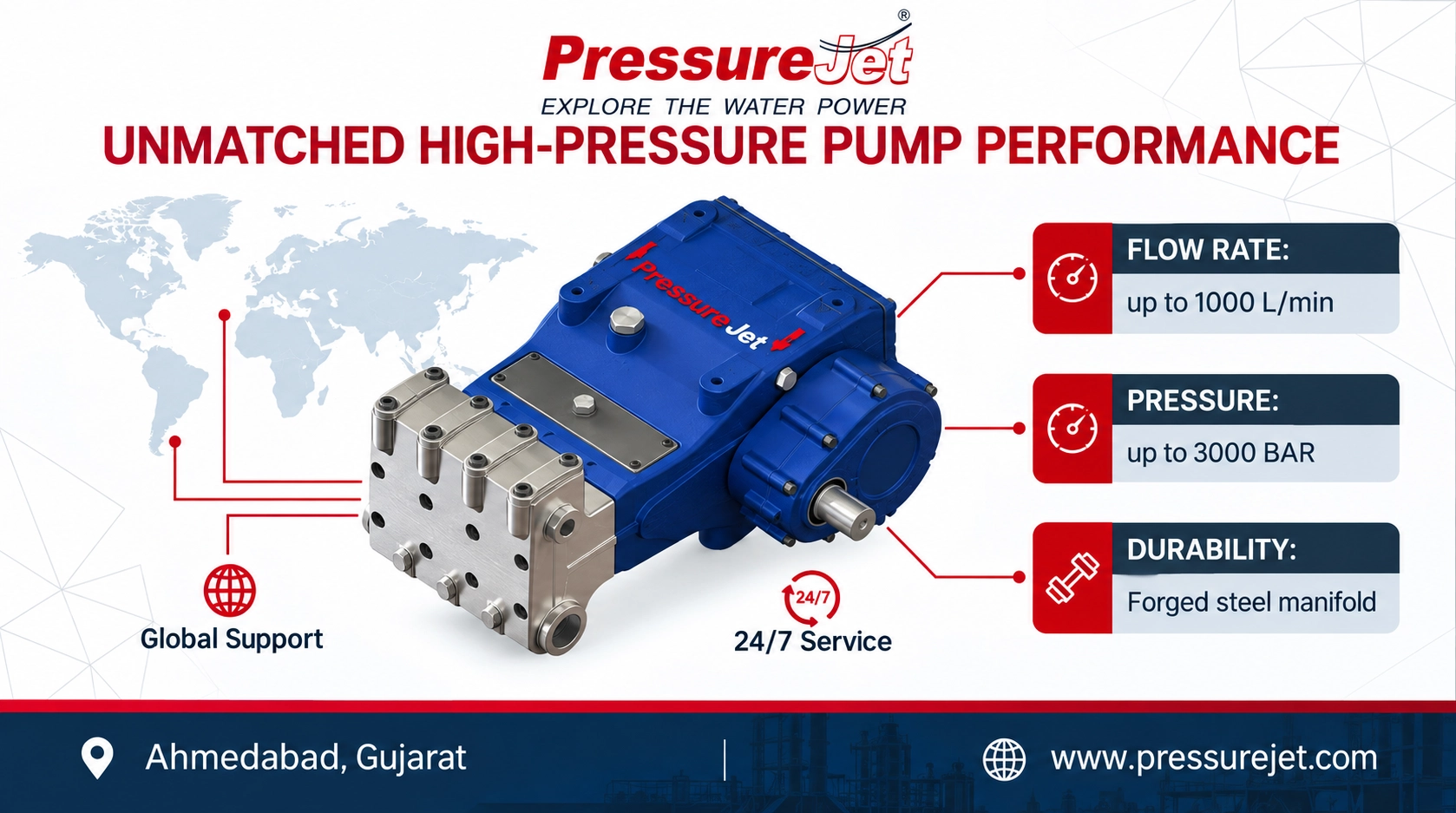
In a typical 500 bar unit, these are the parts to watch:
Packings and seals
Packings hold the pressure around each plunger. They wear with every stroke and with every grain of dirt in the water. The first sign is a small drop in pressure, followed by visible leakage. Changing them on schedule is cheap. Changing them after the leak has scored a plunger is not.
Valves and valve seats
Suction and discharge valves open and close hundreds of times a minute. When a seat wears, flow slips back, and the pump loses efficiency. You may see it as unstable pressure or a pump that runs hotter than usual.
Plungers
Plungers are hard-faced for a reason, but they are still wear items. Scoring, pitting and loss of surface finish all accelerate packing damage.
Power end, bearings and lubrication
The crankcase carries the load of every stroke. Oil level, oil condition, bearing temperature and vibration tell an engineer a great deal long before a failure happens.
Why run to failure costs more than a contract
A pump left to run until it fails will usually fail during a shift that matters. The repair then waits on parts, a technician, and approval. An AMC replaces that sequence with a calendar: parts are changed before they fail, the spares are already in stock, and the engineer already knows the pump.
What a good AMC for a high pressure pump should include
Not every contract is worth signing. Whatever supplier you choose, check that the AMC covers the following, in writing.
Scheduled inspection visits
Visits should be set by running hours, not just by the calendar. A pump that runs three shifts needs a different rhythm from one that runs a few hours a week.
Wear parts and consumables
The contract should say which parts are included (packings, valves, seals, oil, filters) and which are charged separately. Vague scope is the most common cause of AMC disputes.
Performance checks against a baseline
An engineer can only judge a pump against a baseline. PressureJet pumps leave the factory after a 200-hour full-load test, and the quality team verifies them against 694 quality check parameters using 257 quality instruments. That gives service engineers factory values to compare with the pump's behaviour on your site.
Spares and response time
A contract is only as good as the spares behind it. PressureJet keeps a ready spares inventory, so the common wear parts for its pumps do not have to be imported or built to order when you call.
Records and operator guidance
A short service report after each visit, plus guidance for operators on start-up, shutdown and water quality, extends the life of the pump more than most buyers expect.
PressureJet builds its AMC proposals around this list, and each proposal states the visit schedule, covered parts and response expectations for your pump.
What the first 90 days of an AMC look like
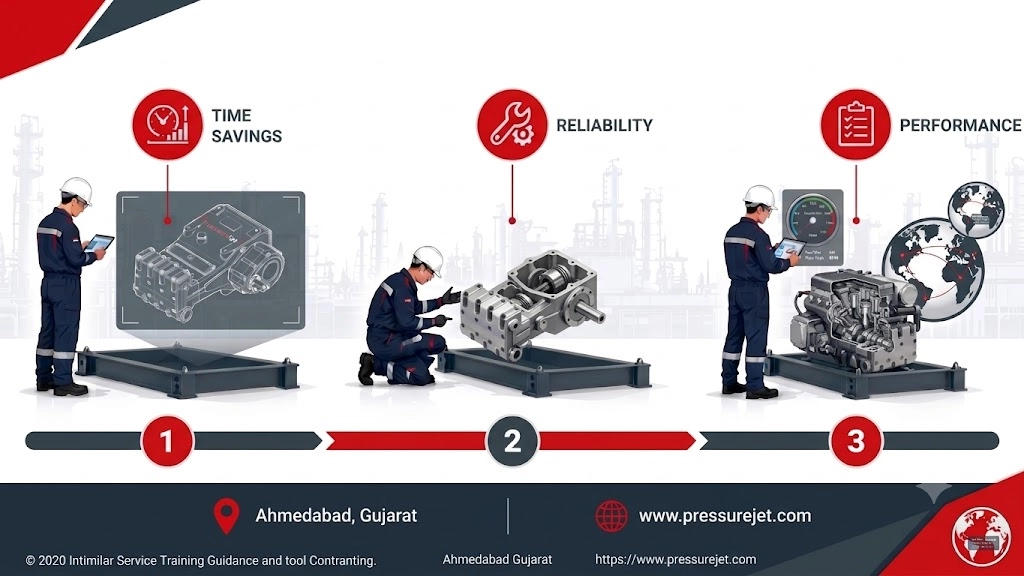
A contract is easier to judge when you can picture the first quarter. A sensible sequence looks like this.
Week one: baseline
The engineer records pressure, flow, oil condition, temperatures and vibration, then compares them with the factory test values. Any difference becomes the first item on the watch list.
Month one: first scheduled service
The first visit usually replaces the parts that wear fastest, checks the water supply and filtration, and confirms that the operators follow the correct start-up and shutdown routine. Many early failures trace back to dirty water or dry running, not to the pump itself.
Month three: review
By now the running hours give a real wear rate. The engineer can tighten or relax the schedule, adjust the spares kit, and flag any part that wears faster than expected. That review is where an AMC starts saving money.
Why a Pump Manufacturer in Ahmedabad Is an Advantage
When the supplier is also the manufacturer, you deal with the people who designed the pump, set its tolerances and tested it. There is no handover between a trader, an importer and a workshop.
A local manufacturer shortens three things: the time an engineer needs to reach your plant, the time a spare part needs to travel, and the time it takes to get a clear technical answer. For Gujarat industry, that matters on the day a line is down.
Trust also comes from scale and history. PressureJet has been building high-pressure pumps for 30 years, has served 5000+ customers in 50+ countries, and delivers 97% of orders on time. A track record of that size is hard to fake and easy to check, so ask for references in your own industry.
How a 500 bar plunger pump helps different industries
Rolling mills and hot steel descaling
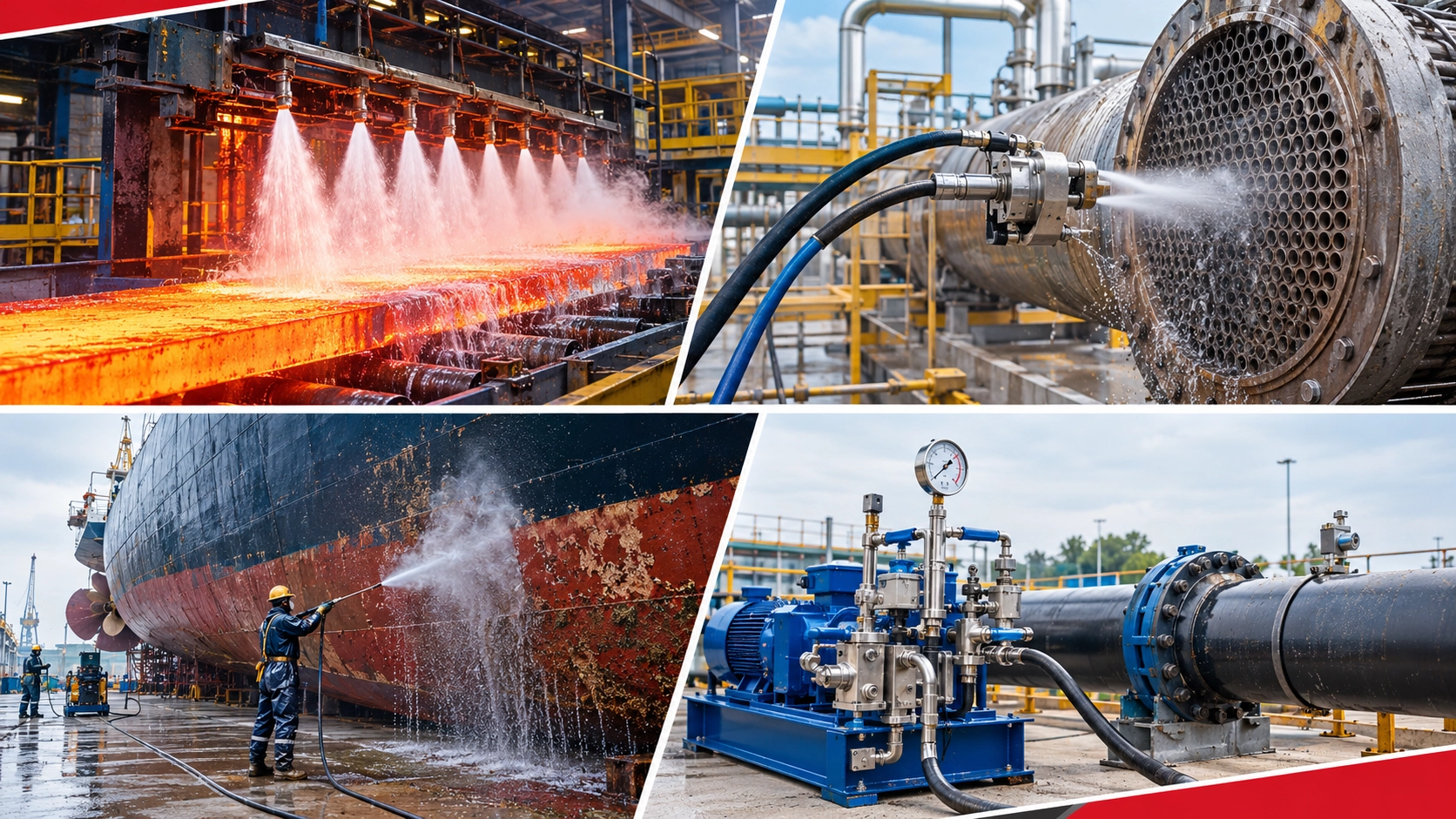
Hot steel forms oxide scale quickly, and it must be removed before the next rolling pass. Hana Votavová and Michal Pohanka describe hydraulic descaling with high-pressure flat jet nozzles as one of the most effective methods for hot-rolled steel in their 2015 conference paper. They also note that nozzles are arranged in overlapping rows and that higher local pressure does not always remove more material. That finding is a useful reminder that the pump, the header and the nozzles work as one system.
PressureJet's hot steel descaling system is built for this duty, including a 150 HP descaling pump. For a mill, the AMC question is simple: how long can the descaling pump be down before the whole line suffers? The answer is usually hours, not days.
Sugar mills and shipyards
Condenser tubes, heat exchangers and hulls gather deposits that only high pressure water removes properly. Sugar mills work to a crushing season, and a shipyard works to a docking window, so both need pumps that are ready when the clock starts. Our article on the sugar mill descaling pump and shipyard hull cleaning pump covers those applications in more detail.
Pipelines, vessels and tanks
Pressure testing is a one-time event for each asset, and the schedule is fixed by the project. A hydrostatic test pump that cannot hold pressure is a delay, a retest and a commissioning slip.
Industrial cleaning and surface preparation
Tube cleaning, tank cleaning and coating removal run on a hydro jetting machine or a hydro blasting machine. These jobs often use contractors who move from site to site, so reliability and quick spares matter more than a spec sheet.
Process plants that need standard compliance
Some projects require pumps built to API 674, the standard for reciprocating positive displacement pumps in petroleum, petrochemical and gas services. Our guide to the API 674 plunger pump India market explains what to ask for in the data sheet.
Triplex or quintuplex: a note for pump selection
A triplex pump has three plungers and a quintuplex has five. In their 2023 paper, Mihael Cipek and colleagues from the University of Zagreb explain that triplex pistons are displaced by 120 degrees and that, in general, a greater number of cylinders gives lower flow fluctuation at a given speed. Their paper also reminds readers that a positive displacement pump does not develop pressure on its own, so every system needs discharge relief devices.
For a 500 bar duty, the practical lesson is to size the pump, the drive and the safety devices together, and to ask the manufacturer to justify the plunger count for your duty cycle.
Water quality and the life of a 500 bar pump
Many buyers focus on the pump and forget the water that goes into it. Dirty water carries grit into the valves and packings, and grit is the fastest way to turn a planned service into an unplanned one. A suction filter that is cleaned on schedule, a clean tank, and correct inlet conditions often do more for pump life than any upgrade. An AMC visit should always include a look at the water side of the system.
Questions to ask any AMC provider
Before you sign with anyone, including us, put these questions to the supplier and ask for the answers in writing.
- Which parts and consumables are included in the fee, and which are extra?
- What is the response time for a breakdown, and who commits to it?
- Which spares are held in stock, and how many of each?
- Who performs the work, and are they trained on this pump model?
- What reports will I receive after every visit?
A confident manufacturer answers these in a page. A reluctant one answers in generalities.
Case reference: how an AMC works in practice
| Field | Detail |
|---|---|
| Customer and industry | Steel rolling mill, Ahmedabad, Gujarat, India |
| Application | High-pressure hot steel descaling for removing oxide scale from steel surfaces during rolling mill operations. |
| Pump supplied | High-pressure plunger pump system pressure |
| Problem before PressureJet | The customer needed a reliable descaling solution to maintain consistent water pressure, minimize unplanned downtime, and ensure timely access to maintenance support and genuine spare parts. |
| What PressureJet did | PressureJet Systems supplied a high-pressure pumping solution selected for the application's operating requirements. Project support may include installation, commissioning, operating guidance, preventive maintenance planning, and spare parts support, depending on the actual scope of supply. |
| Result | The system was intended to support reliable descaling performance and smoother maintenance planning. Add verified results, such as uptime improvement, reduction in downtime, or maintenance response time, once measured data is available. |
| Customer comment | Exact approved testimonial here. |
How to start an AMC with PressureJet
Gather these details before you call, and the quote will be faster and more accurate:
- Pump model and serial number
- Working pressure in bar and flow in LPM
- Running hours per day and per year
- Water source and filtration
- Site location and access constraints
- Any history of past failures
Send them to the PressureJet team, and an engineer will propose a visit schedule, a list of covered parts, and a recommended spares kit.
Why brand trust is a technical issue
For a 500 bar pump, trust is not a slogan. It is a pump that has completed a 200-hour full-load test, a factory with 257 quality instruments and 694 checks, a delivery record of 97% on time, and a spares shelf that is already stocked. If a supplier cannot show you comparable proof, compare carefully. For a wider look at how to compare suppliers, read our guide to the best pressure pump manufacturers in India.
Frequently Asked Questions About PressureJet
What pump should I use for hot steel descaling in a rolling mill?
Hot steel descaling needs a high-pressure plunger pump that delivers steady pressure and flow for continuous duty, so the water jets break and remove mill scale from the hot surface. The right model depends on the required pressure, flow, number of nozzle headers and mill speed. PressureJet manufactures hot steel descaling systems, including a 150 HP descaling pump, and sizes each pump to the mill's actual duty.
Which equipment is used for sugar mill condenser tube cleaning?
Sugar mill condenser tubes are cleaned with high-pressure water jetting equipment: a plunger pump, a high-pressure hose, and a lance or flexible jetting tool that clears scale and deposits from inside the tubes. PressureJet makes hydro jetting machines and pumps for sugar mill cleaning, supplied with spare parts support so cleaning is not delayed in the crushing season.
I need 400 bar at 180 LPM continuous duty - who supplies this?
PressureJet designs and manufactures high-pressure plunger pump systems for continuous duty and can quote a 400 bar, 180 LPM unit. As a guide, the hydraulic power for that duty is about 120 kW (pressure in bar multiplied by flow in LPM, divided by 600), and the drive must be sized above this after allowing for pump and transmission losses. Share your fluid, duty cycle, and site power or diesel preference so engineering can confirm the exact model.
Who supplies API 674 compliant high pressure pumps from India?
API 674 is the standard for positive displacement reciprocating pumps used in demanding process service. PressureJet supplies API 674 plunger pumps from India, including diesel engine-driven versions, and every pump goes through a 200-hour full-load test and 694 quality check parameters. Please send your data sheet so we can confirm the compliance scope for your project.
Who supplies diesel engine driven high pressure pumps for 300 bar?
PressureJet manufactures diesel engine driven high pressure pumps for sites where grid power is unreliable or unavailable, including 300 bar duty. Pump, engine, base frame and controls are matched as one package, and ready spares inventory supports servicing.
Triplex vs quintuplex plunger pumps: which is better for descaling?
A triplex pump has three plungers and a quintuplex pump has five. Triplex pumps are simpler and easier to maintain; quintuplex pumps give smoother flow with less pulsation and vibration, which helps in long continuous-duty descaling lines. The right choice depends on pressure, flow, duty hours and maintenance capability, and PressureJet can recommend one after reviewing your duty.
Conclusion
A 500 bar plunger pump is a long-term commitment, so choose the supplier before you choose the model. Look for a pump manufacturer in Ahmedabad that tests every pump for 200 hours at full load, checks it against 694 parameters, keeps spares ready and offers a clear AMC. That combination protects your line from the day of commissioning to the day of replacement.
Back to Blog
Parameters

Customers

Manufacturing

Expertise