

High Pressure Plunger Pump Selection Guide, 140 to 1400 bar
Discover PressureJet pump series designed for industrial cleaning, steel descaling, sewer jetting, and fire fighting applications.
Choosing a high pressure plunger pump is rarely about one number. An engineer who asks for "a 1000 bar pump" has named the pressure, but not the flow, the duty cycle, the drive, the water quality or the accessories that keep the system safe. Get any of these wrong and the result is a pump that runs hot, wears quickly or simply cannot do the job it was bought for.
This guide walks through the selection process for the 140 to 1400 bar range, which is the span PressureJet lists for its triplex plunger pumps and custom systems, with flow from 8 LPM to 485 LPM. It is written for purchase managers, maintenance heads, plant engineers and contractors who want to write a clear specification before they ask for a quotation.
Quick answer: Select a high pressure plunger pump in this order: application, working pressure, flow rate, drive power, water quality and safety accessories. Check hydraulic power with kW = bar x LPM / 600, allow for losses, and then confirm the final duty data with the manufacturer.
What a high pressure plunger pump actually does
A triplex plunger pump uses three plungers that move in sequence inside a fluid end. On the suction stroke each plunger draws in filtered water through a valve. On the discharge stroke it pushes that water out through another valve into the high pressure line. Because three plungers overlap, the delivery is smoother than it would be from a single plunger.
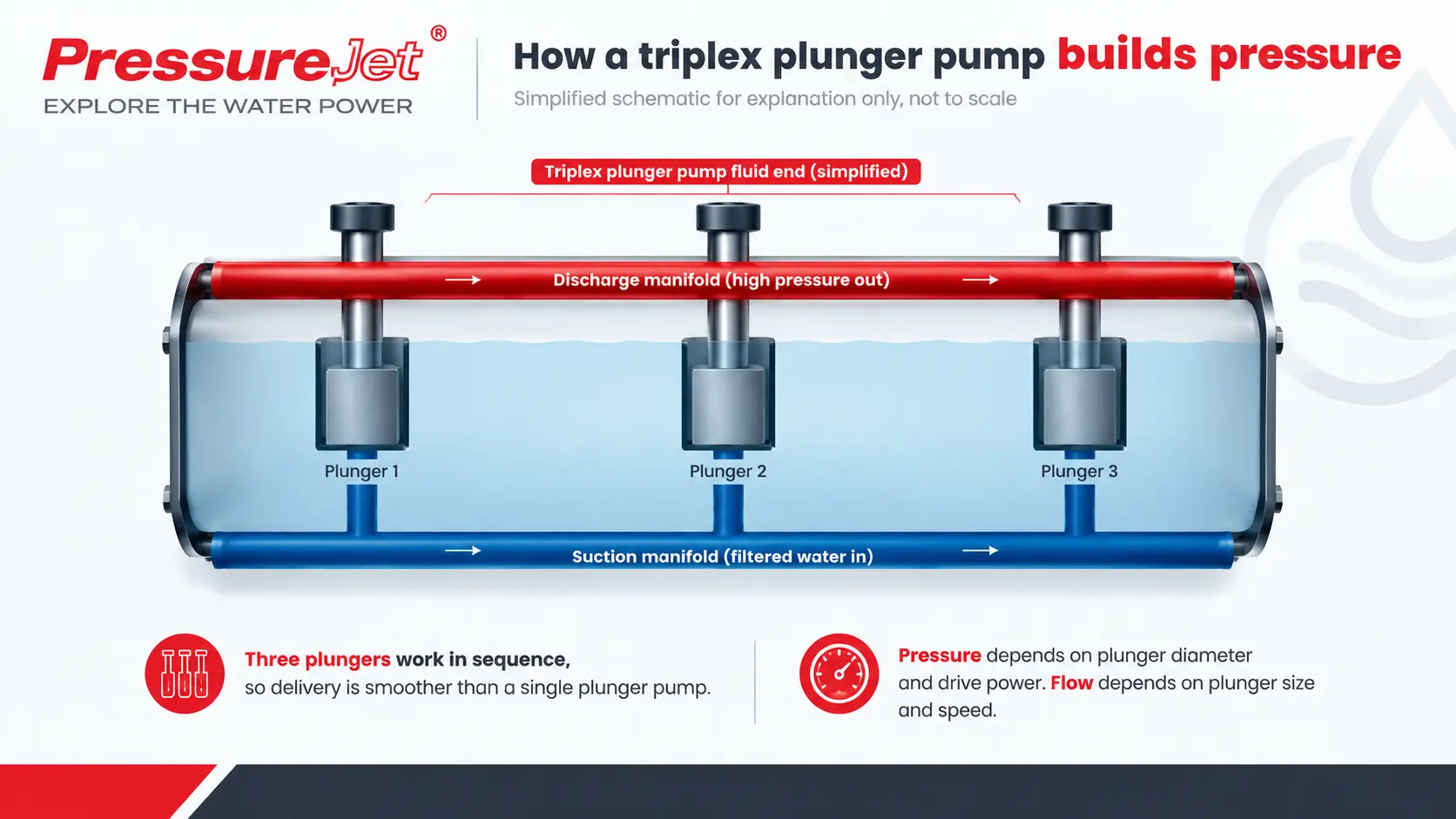
Simplified schematic of a triplex plunger pump fluid end. For explanation only, not to scale.
Two ideas follow from this. First, flow depends on plunger size and pump speed. Second, pressure is limited by the plunger diameter the pump is built with and by the power driving it. This is why a pump designed for 1400 bar delivers far less water than a pump designed for 200 bar when both use a similar amount of power.
Understand the pressure bands from 140 to 1400 bar
The wide pressure range is not one market. It is several distinct duties that happen to share the same pump technology. Reading the bands correctly is the fastest way to avoid over-buying or under-buying.
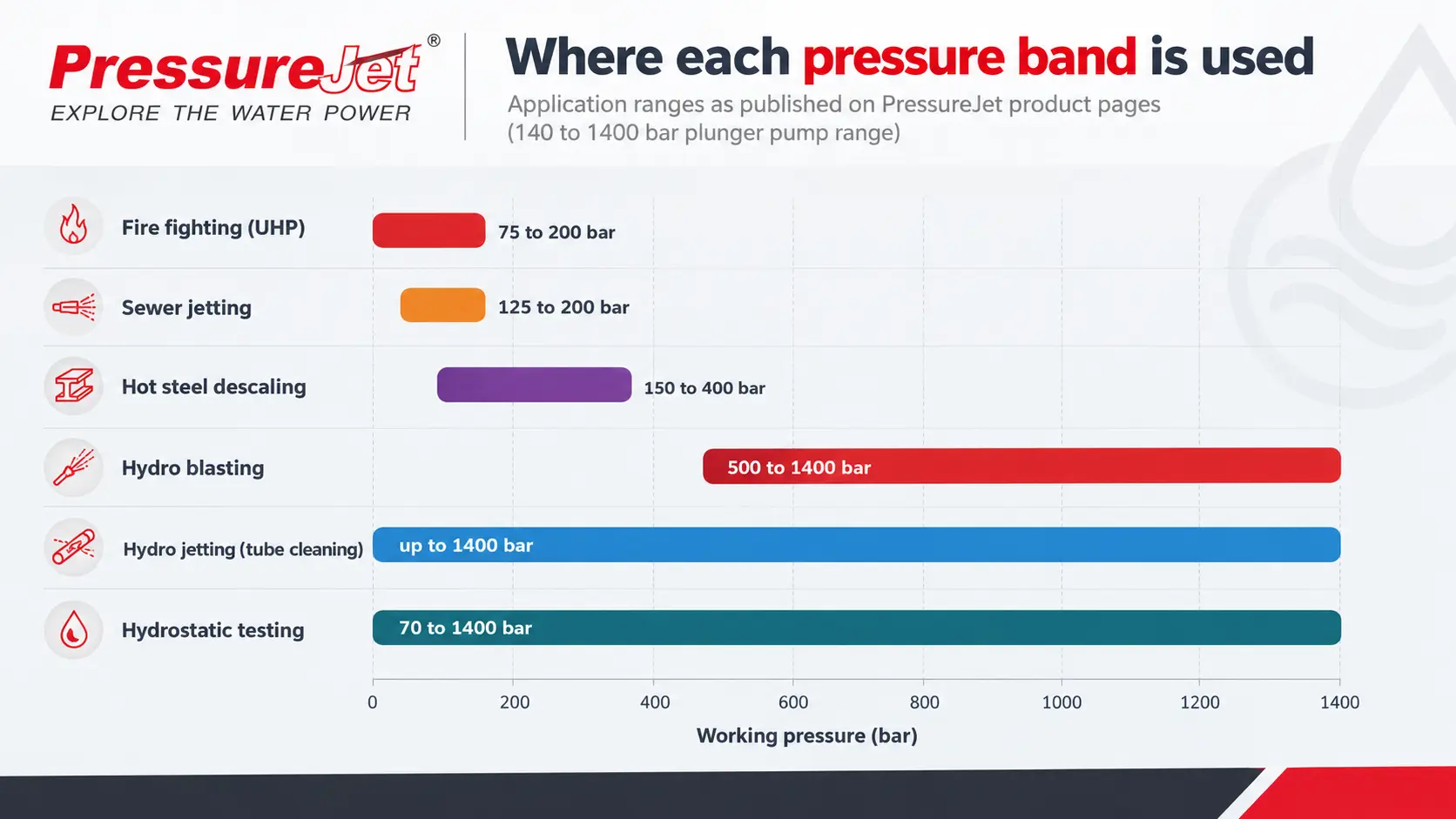
Application ranges as published on the PressureJet product pages.
- Roughly 75 to 200 bar: high flow duties such as UHP fire fighting pump systems and sewer cleaning.
- 150 to 400 bar: hot steel descaling, where flow is high and the jet must clear scale quickly from moving steel.
- 500 to 1400 bar: hydro blasting for coatings, concrete and stone surfaces.
- Up to 1400 bar: tube and pipe cleaning with a hydro jetting machine, and hydrostatic testing of vessels, valves and pipelines.
A six step method to select the right pump
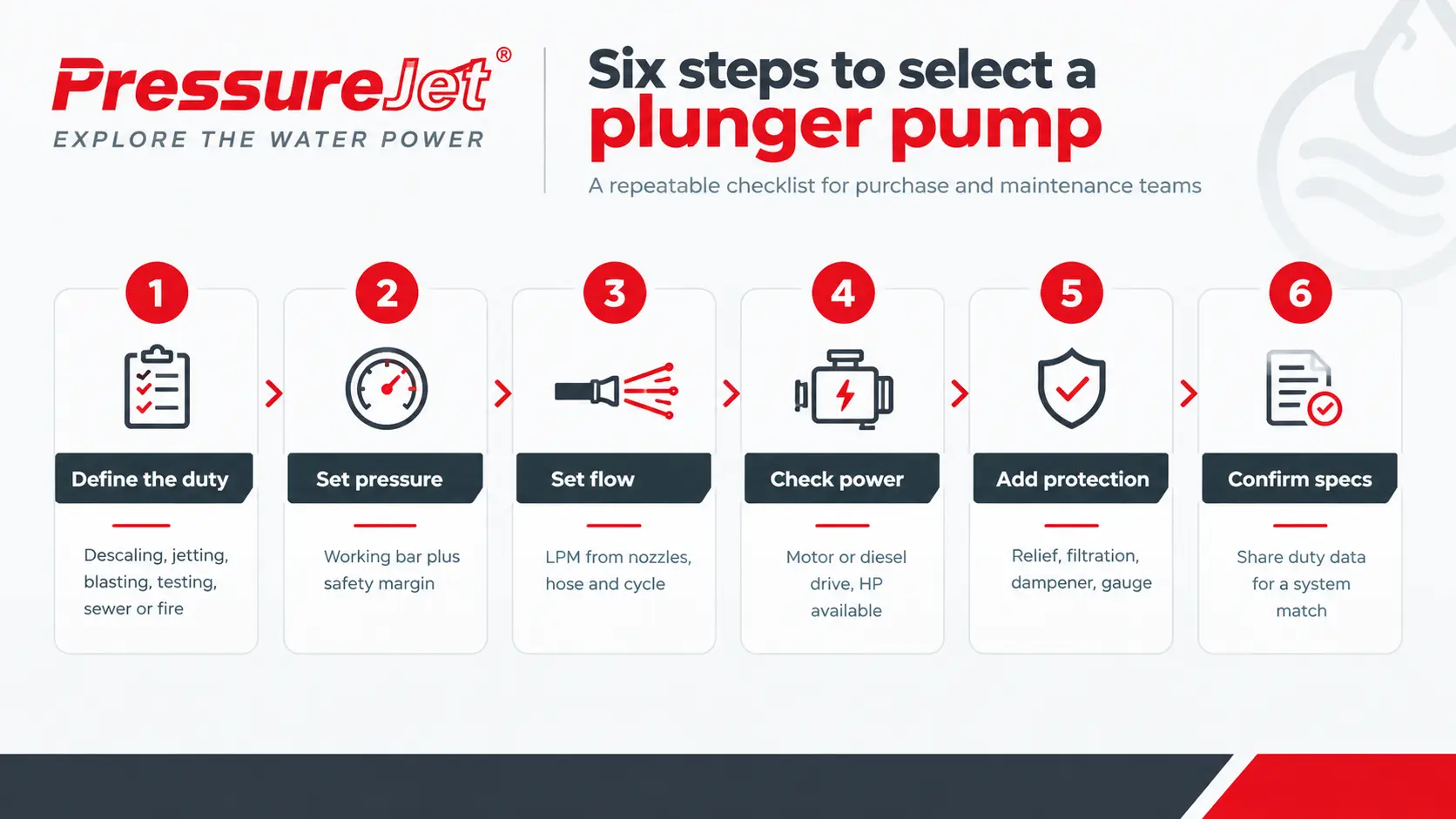
A repeatable checklist for purchase and maintenance teams.
Step 1: Define the duty in plain words
Write down what the water must do. Remove scale from hot billets. Test a pressure vessel without a leak. Clean the inside of heat exchanger tubes. Strip paint from a hull. Clear a blocked sewer line. Suppress a fire. The duty decides everything that follows, including whether the pump runs continuously or in short bursts.
Step 2: Set the working pressure
Choose the pressure the job needs, not the highest pressure available. Cleaning soft deposits at 1000 bar when 500 bar would do wastes power and shortens the life of seals, hoses and nozzles. For testing work, the pressure is set by the test standard or the pressure rating of the item under test. Ask the manufacturer what margin between working pressure and maximum rating they recommend for your duty.
Step 3: Set the flow rate
Flow is decided by the nozzles, lances or headers that will consume the water. Add up the flow of every nozzle running at once, then include any bypass. A tube cleaning lance needs a small flow at very high pressure. A descaling header or a sewer nozzle needs a much larger flow at lower pressure. Specify flow in LPM at the working pressure, not in isolation.
Step 4: Check the power requirement
Pressure and flow together decide the power. The standard relationship is hydraulic power in kW equals pressure in bar multiplied by flow in LPM, divided by 600. A pump delivering 30 LPM at 1000 bar therefore needs 50 kW of hydraulic power before losses. The drive must be larger than that figure to cover mechanical and volumetric losses.
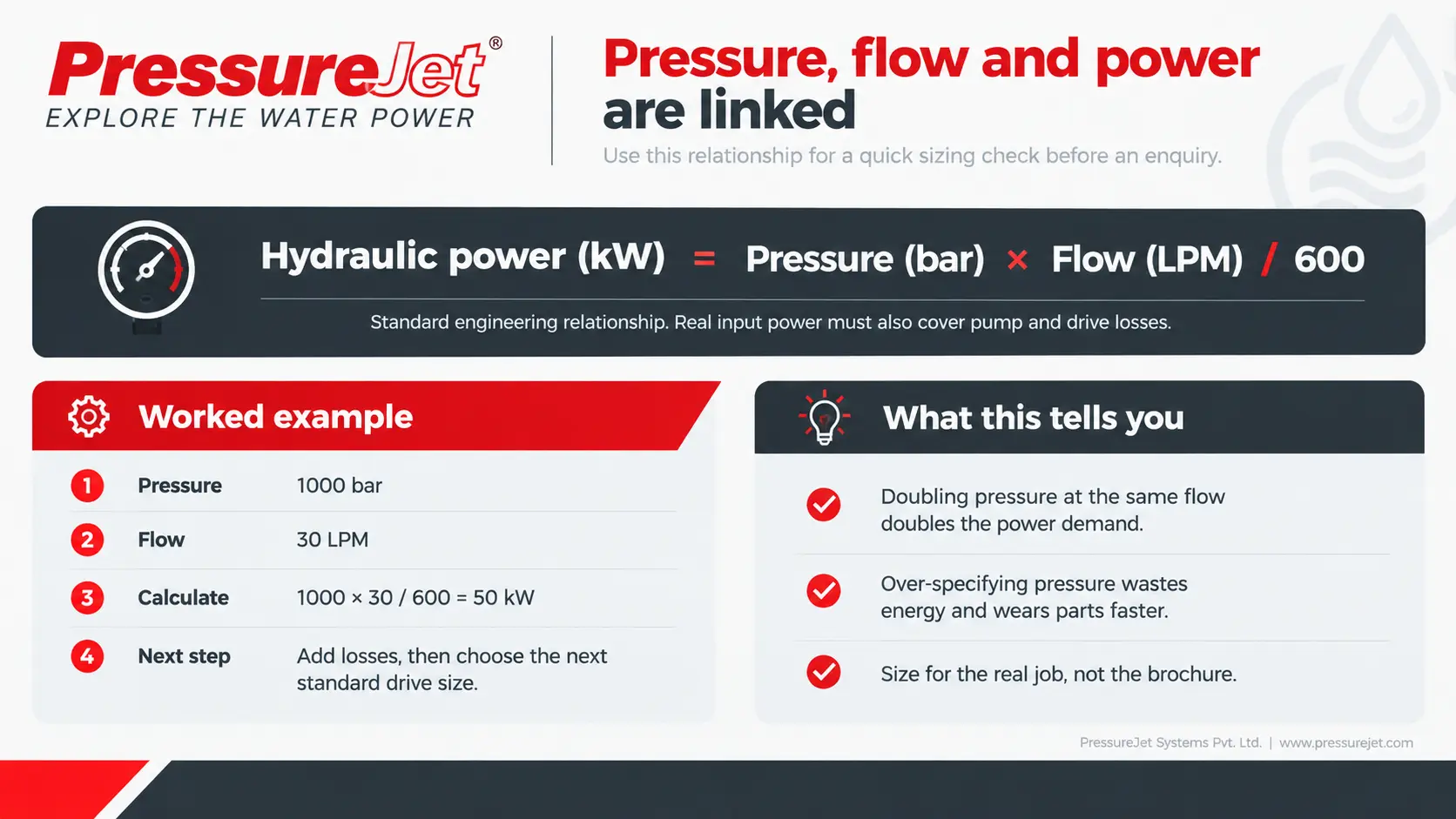
Use the relationship for a quick sizing check, then confirm with the manufacturer.
Doubling the pressure at the same flow doubles the power demand. This is the main reason over-specifying pressure is expensive, both in purchase cost and in running cost.
Step 5: Choose the drive and the mounting
Electric motor drive suits workshops and plants with a reliable supply. Diesel engine drive suits remote sites and oilfields. PressureJet lists both motor driven and diesel driven options for its hydro test systems. Mounting matters too. A trolley mounted unit is easy to move between plant areas, while a skid mounted system suits a fixed installation such as a rolling mill.
Step 6: Plan the water and the accessories
Plunger pumps need clean water. Grit and scale damage valves and plungers quickly, so filtration is part of the pump specification, not an afterthought. The next sections cover how this fits with each application and which accessories belong in the package.
Match the pump to the application
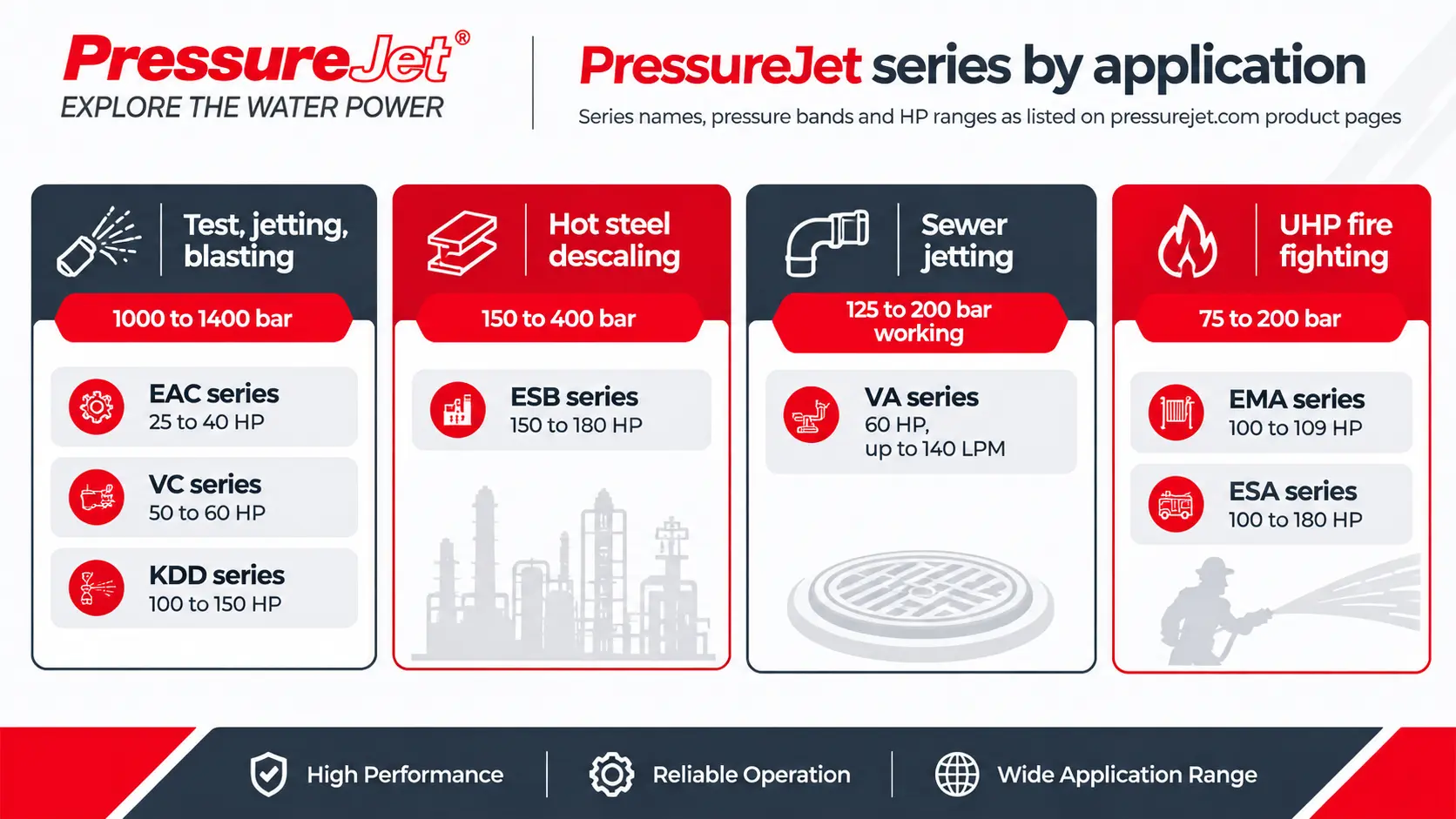
The table below summarises the series and power ranges that PressureJet lists on its application pages. Use it as a starting point for a conversation, since the final configuration depends on your duty data.
Series names, pressure bands and HP ranges as listed on pressurejet.com.
Hot steel descaling
Scale forms on steel during reheating, and it must be removed before rolling so that it does not mark the product or wear the rolls. A hot steel descaling system works at 150 to 400 bar and needs high flow. The ESB series is listed at 150 HP to 180 HP, so a 150 HP descaling pump sits at the lower end of that range, while larger rolling lines move up the scale. When you shortlist a hot metal descaling machine manufacturer India wide, also ask about header design, nozzle options and valve control, because the pump alone does not remove scale.
Hydrostatic testing
Hydro testing fills a pipe, vessel, boiler or valve with water and raises the pressure to prove strength and find leaks. PressureJet describes low volume, very high pressure testing up to 1400 bar and high volume testing at lower pressures up to 500 bar, with flow from 8 to 485 LPM. A hydrostatic test pump that suits a small valve test is wrong for a long pipeline, so state the test volume and the time allowed to reach pressure. Anyone sourcing hydrostatic pressure testing equipment should also ask about relief devices and control, since safe pressurisation matters as much as the pump.
Hydro jetting
Heat exchanger, condenser and evaporator tube cleaning calls for very high pressure with modest flow. A hydro jetting machine in the 1000 to 1400 bar band is listed in the VC series at 50 to 60 HP and the KDD series at 100 to 150 HP. Sugar mills, refineries and shutdown contractors use this duty during maintenance windows, so reliability on the day matters more than a small price difference.
Hydro blasting
Surface preparation, paint removal, rust removal and kiln cleaning use jets that strike a surface rather than travel down a tube. A hydro blasting machine is offered across 500 to 1400 bar, and the choice of nozzle and gun is as important as the pump. Contractors comparing a high pressure water jet blasting machine should check the pressure rating of every accessory in the line, because a gun rated for 1000 bar cannot safely sit on a 1400 bar system.
Sewer jetting
Sewer work needs large flow at moderate pressure. PressureJet lists a working pressure of 125 to 200 bar and flow up to 485 LPM for its sewer range, with the VA series at 60 HP for flow up to 140 LPM. A sewer jetting pump is usually mounted on a vehicle, so weight, drive arrangement and nozzle choice for the pipe diameter all affect selection. Fleet owners and municipal buyers often look for a sewer jetting machine manufacturer that can also supply the nozzles.
Fire fighting
UHP fire suppression uses a plunger pump to produce a fine, fast jet that reaches a fire with less water. PressureJet lists 75 to 200 bar with flow from 14 to 485 LPM, and the ESA and EMA series carry 100 HP and above. When a fire truck builder reviews fire pump manufacturers, readiness and spare parts support count as much as the datasheet.
Protect the pump and the people around it
A pump that develops 1400 bar is a hazard if the system around it is poorly protected. Every specification should list the safety and conditioning items below.
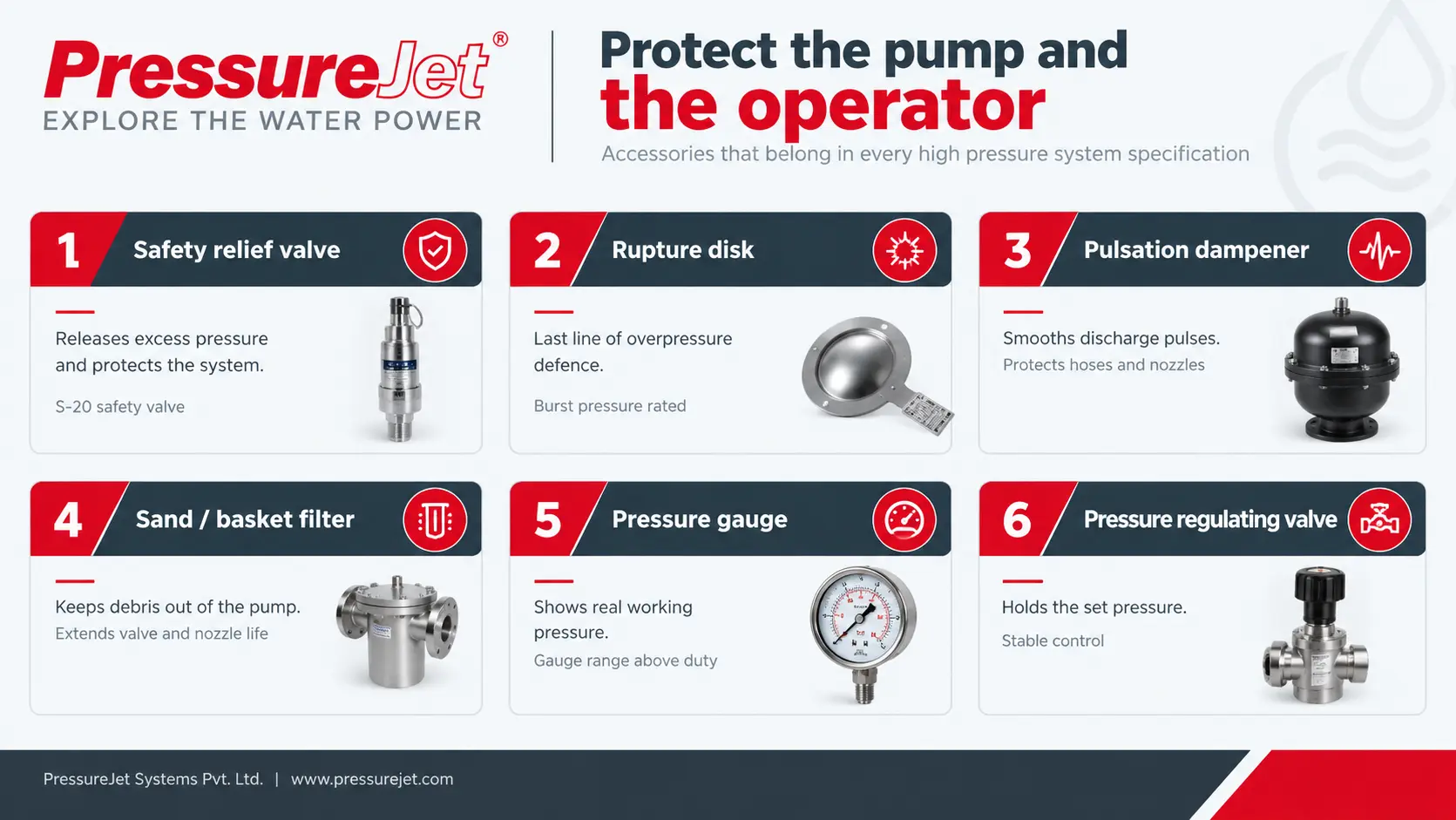
Accessories that belong in every high pressure system specification.
- Safety relief valve and rupture disk to release excess pressure before something fails.
- Pulsation dampener to reduce pressure fluctuation and vibration from a reciprocating pump.
- Sand and basket filters to keep debris away from valves, plungers and nozzles.
- Pressure gauge and pressure regulating valve to show and hold the working pressure.
- Operator protection such as a safety suit and a flexible lance safety stop for hand held and tube cleaning work.
Mistakes that cost money after purchase
- Selecting on pressure alone and ignoring flow, so the pump cannot feed the nozzles.
- Specifying the maximum pressure for every job instead of the pressure the job needs.
- Skipping filtration, then replacing valves and plungers far too often.
- Buying a pump without checking that hoses, guns and nozzles carry the same pressure rating.
- Ignoring spare parts availability until the first breakdown.
What to send when you request a quotation
People searching for a hydrostatic pump for sale, a hydro jetter for sale or a jetter machine for sale often start with a price question. A manufacturer cannot quote well without duty data, so send the following:
- The application and the industry.
- Required working pressure in bar and flow in LPM.
- Electric or diesel drive, and the power supply available.
- Fixed, skid or trolley mounting.
- Continuous or intermittent duty, and the hours per day.
- Water source and quality.
- Accessories needed, such as valves, guns, lances and nozzles.
Why testing and service history matter
A pump selection is only as good as the pump you receive. PressureJet states that its plunger pumps go through a 200 hour full load test, and that its quality process covers 694 check parameters. The company also reports more than 30 years of experience and customers in over 50 countries. Ask any supplier for equivalent information, along with spare parts stock and service support, before you commit.
Frequently asked questions
How do I choose the right pressure for a high pressure plunger pump?
Start from the application, not the catalogue. Cleaning, descaling, blasting, testing and fire fighting each work in a different pressure band. Choose the pressure the job needs, then ask the manufacturer what margin to keep between working pressure and the maximum rating.
How do I calculate the flow rate I need?
Add the flow of every nozzle, lance or header that will run at the same time, then include any bypass flow. State the result in LPM at the working pressure. Flow and pressure together decide the power, using kW = bar x LPM / 600 before losses.
What is the difference between a hydro jetting machine and a hydro blasting machine?
Both use high pressure plunger pumps. Hydro jetting usually cleans the inside of tubes and pipes using lances and rotary nozzles. Hydro blasting usually works on external surfaces, removing paint, coatings, rust or concrete with guns and blasting nozzles.
Can one pump be used for hydro testing and for cleaning?
Not without checking the duty. Testing needs controlled pressurisation and safe pressure holding, while cleaning needs continuous flow through nozzles. Share both duties with the manufacturer so the pump, valves and controls can be matched to each.
Which accessories are essential on a high pressure system?
At minimum, include a safety relief valve, a rupture disk where the pressure is very high, a pulsation dampener, suitable filtration, a pressure gauge and a pressure regulating valve. Add operator protection for hand held work.
Need a pump matched to your duty? Send your application, pressure, flow and drive details to the PressureJet team through the enquiry page, call +91-9375022359 or write to sales@pressurejet.com. For rolling mills, tube cleaning, testing, blasting, sewer or fire applications, the team can suggest a configuration for your plant.
Back to Blog
Parameters

Customers

Manufacturing

Expertise